

People trying to get better outcomes can learn a lot from Leo Tolstoy. Just as each unhappy family is unhappy in its own way, unhappy feedback is often multi-dimensional.
The problem with simple sentiment metrics is that they flatten this diversity, and in the process can suppress crucial signals.
As a quick example, suppose there are six different things people could be negative about, but only one of these really drives outcomes. People might mention a combination of things, which gives you 2^6 = 64 different ways an individual could be "negative".
If you collapse all of that into a single positive/negative score, you throw away the structure that actually explains what's going on. A crude sentiment plot (below left) can hide the impact of different drivers. These only become visible when you untangle the underlying reasons (below right).
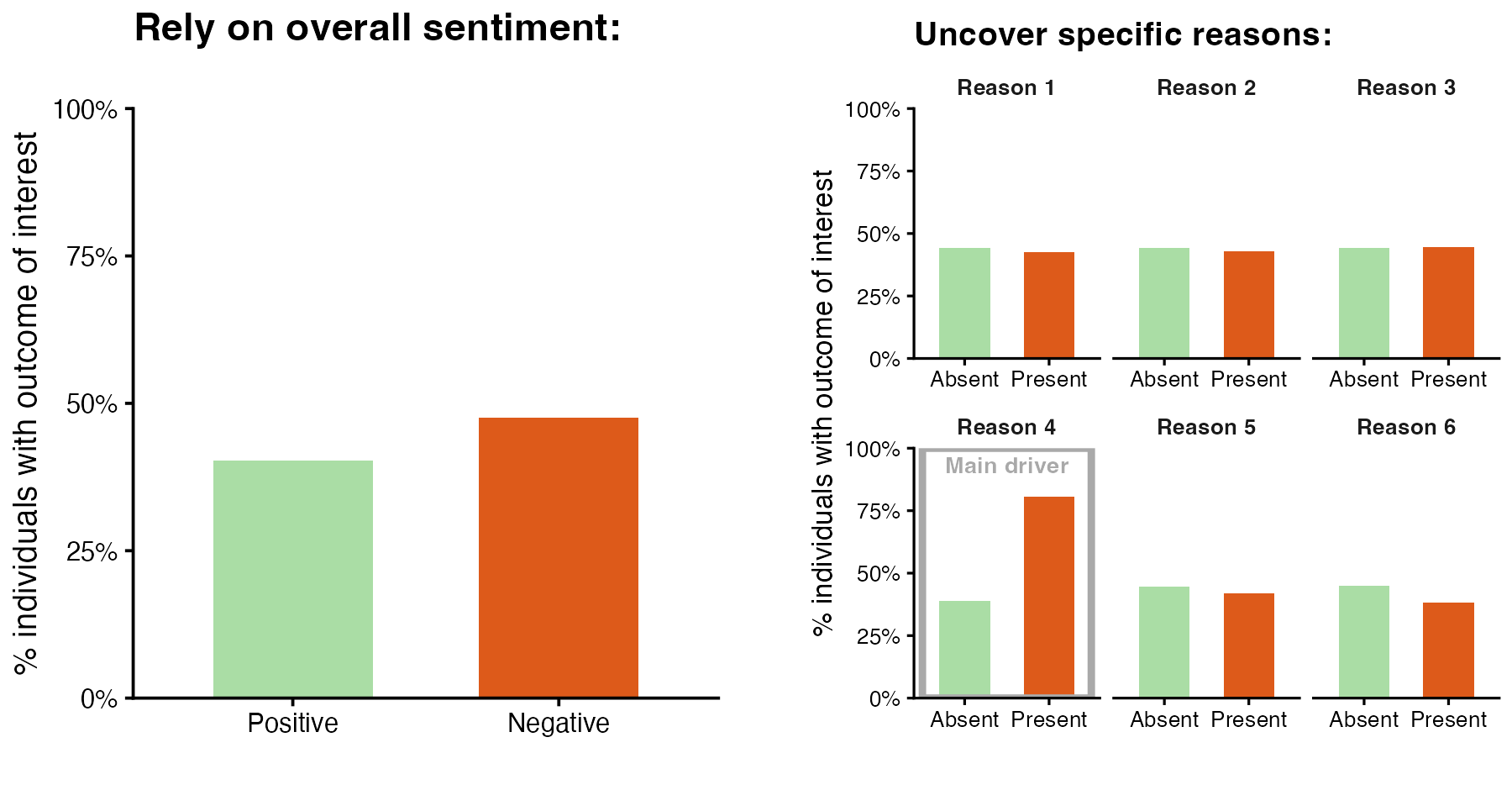
We've seen this exact situation working with real clients. Outcomes were strongly linked to a single underlying source of dissatisfaction, even when overall sentiment barely moved.